
Digital Marketing is in the midst of an AI evolution that’s changing how people search, how content is cited, and how small businesses market themselves. AI offers time-saving tools not just for search but also for content creation and marketing planning, helping the small business owner be seen and get found. In this video — the first of a series of 3 — I show you the basics of how all this works together and give you strategies on how to adapt and adopt the new marketing in this AI-Driven World.
The AI Evolution in Digital Marketing
It’s all about Conversions
That’s the bottom line. Whether it’s sales on an ecommerce site, getting the phone to ring, or lead generation, the purpose of all of your marketing efforts is to get CONVERSIONS! Conversions are still your goal — that hasn’t changed. What has changed is how your potential customer is going to get there — how are they going to find you?
What are the Steps to Effective Marketing?
- Define Your Target Market(s). You can have more than one.
- Research – Learn as much as you can about your target. Here’s where AI can help you.
- Set SMART Goals of what specifically you want to accomplish.
- Strategic & Tactical Plans. Outline the strategies to accomplish your goals. Then the Tactical Plan is how you’re going to implement the strategy.
- Set up, Brand & Optimize your website, as well as your social media profiles for AI-SEO. Make it easy for them to find and cite your content.
- Learn how to properly and effectively use the Time-Saving AI Tools
- Create Content – write blog posts, record videos or podcasts, all optimized for the AI bots.
- Implement, Engage, & Build a Following. SHARE, don’t sell! Just do it! Get your content out there strategically.
- Email Automation to entice sales – don’t let hot or warm leads fall through the cracks.
- Monitor & Measure Monthly – Check your analytics, insights, and your key performance indicators (KPIs), to see what’s working and not working, and adjust your strategic and tactical plans accordingly.
Really Get to Know Your Audience

If your target customer has a question, a problem, or a pain point, they’re now, more than likely, going to ask their favorite AI Search Tool. The question is which tools? Where are they searching? What are they asking? How do I know when they’re ready to make a decision? How do you get your content cited in the AI search results? You need to re-strategize your digital marketing.
SMART Goal setting is a basic part of any business. You want to start with SMART, describing what you want to accomplish with your digital marketing in the next 30 days. Do them month-to-month.
For instance, what’s your conversion rate? You determine this by your analytics. If you had 100 visitors and 10 downloaded the offer, you have a 10% click-through/conversion rate. Average on-website conversion click-through rates are 1-3%, but they will vary by industry. That means you need to attract A LOT of traffic and have a great offer of interest to your target audience to meet your goals. At the end of the month, you analyze your analytics and see what worked and what didn’t work, and adjust your goals, strategies, and tactics for the next month. Though the tools have changed, and the media outlets have changed, marketing basics have not.

What has changed is the AI Evolution
What is an LLM?
LLM stands for Large Language Models. They are also called AI Assistants or AI Agents, and they make up 56% of global search volume. Yes, they are taking over search very quickly.
Google is still very much in the game. Their AI is Gemini. On Desktop or the Google mobile app, you can turn on AI Mode, which is technically a research assistant rather than a search engine. Tap on the beaker icon, and you’ll go to Google Labs and turn on experiments.
If you don’t like Google, then go over to Bing and try Microsoft’s Copilot, which uses the popular ChatGPT. 80% of Americans use ChatGPT as an answer engine, with ~ 900 million weekly active users. What is a “GPT”? Generative Pre-trained Transformer. And you can create your own! That’s for another class!
And there are more! Grok from X, Perplexity, Claude, and a cool tool from Google, NotebookLM. Recently, to write an article on how AI is changing search for 2026, I uploaded 45 resources, including videos, ebooks, and website links to Notebook LM, and I had a draft of a 1200-word article in less than 5 minutes. I was blown away. I still had to edit it and add my own E-E-A-T to it.

What is the Future of AI Search?

You cannot deny that this is the future of search and digital marketing. In the last year, I’ve watched countless webinars, read dozens of articles and ebooks, trying to wrap my brain around all this. This quote by Kristina Bergwall, on Search Engine Land, describes the bottom line…
“The future of organic search will be shaped by LLMs [large language models] alongside traditional algorithms. Optimizing for rankings alone is no longer enough.”
Kristina Bergwall, Search Engine Land
How is AI Different?
Ranking on an AI platform is different from ranking in the old Google Search. Actually, there is no ranking anymore. It’s all about being cited…
- 87% are question-based searches
- They answer questions in short summaries.
- AEO: Answer Engine Optimization
- GEO: Generative Engine Optimization
- AIOs: AI Overviews
- AI search bots scrape content from everywhere.
- Websites
- Social Media
- Machine Learning / Human Input
So what happens when an LLM encounters a question it can’t answer with confidence, despite the massive amount of training data? That’s where RAG comes in.
What is RAG?
RAG stands for Retrieval-Augmented Generation. The AI search bots use real-time web search to keep responses fresh and accurate, bridging the limits of static training data. In other words, the LLM runs a web search, but it does it in seconds. You don’t even notice.
Where do the AI Search Bots get their information?
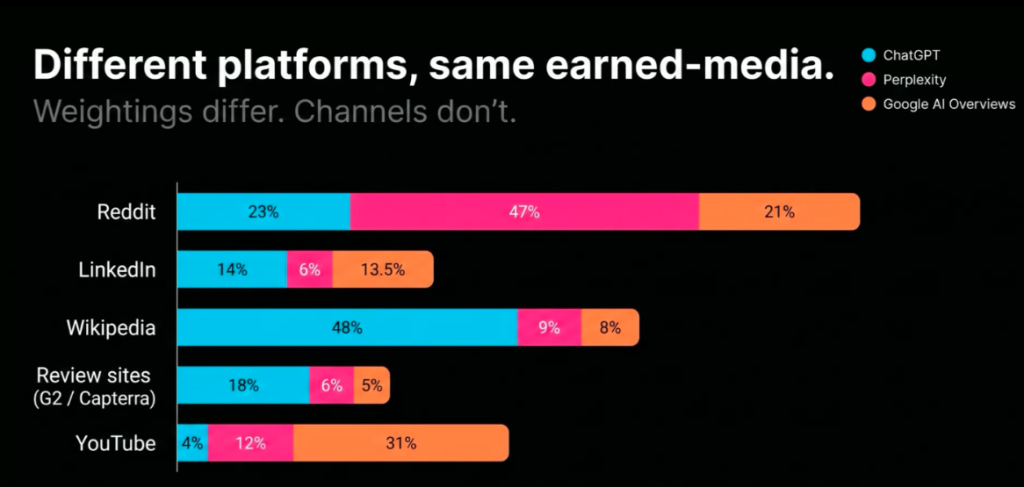
The AI search bots scrape EVERYTHING from EVERYWHERE for information. This data changes constantly, so this is just to give you an idea of where the AI bots go to find information. This chart is from a webinar presented by Search Engine Journal and Sam Garg, Founder and CEO of Writesonic, on April 23, 2026.
The AI Evolution
These stats are constantly changing, but this gives you an idea of where you need to be to get found. The top ones will change positions, but they still remain on top.
If you’ve been doing SEO content marketing correctly, then adapting to AEO is easy; it’s basically long-form SEO. In other words, people are asking questions. You need to provide the answers.
- Reddit lands in the top 3 most of the time.
- LinkedIn will swap places with the top 3.
- YouTube usually lands in the top 3.
What does it take to be cited in the AI Answer Engines?

You still need to be a content magnet, but for the AI-bots. Before, I used to tell people to write for the human reader with the search engine in mind, but now it’s: write for the human reader with the AI-Search Bot in mind.
- Gain Brand Mentions
- Share fresh content everywhere
- Be consistent – duplicate content OK
- Join forums, podcasters, expert roundups, etc.
- Share recent stats and examples.
- First-person insights & original research.
- Structure for AI-Bots
- What questions is your target asking?
- Put the question in a subheading (H2 or H3)
- Give a direct answer first, then details and lists.
- Show “last updated,” & add date
- Have clear author bios and authoritative citations.
Now more than ever, EEAT is crucial.
What is E-E-A-T?
- Experience — This is something AI can’t provide — YOUR personal experience on a subject. Demonstrate first-hand knowledge and practical involvement with a topic.
- Expertise — Possessing a high level of knowledge or skill in a particular field or industry.
- Authority — Are you the go-to person on this subject? Are you a recognized, widely cited source of information in a field or industry?
- Trustworthiness — The reliability, accuracy, and safety of the content, site, and author. Can you be trusted? Can this information be trusted? Are you a trusted source? Are you legit? Remember this! It’s important! This is what both Google and the AI-bots look for, as well as potential customers. In fact, this is a huge issue right now. The searcher doesn’t know who to trust.
How Do You Build Trust?

Though you’re trying to attract the AI bot, you’re still writing for the human who’s doing the searching. Write for your human target market, speak their language. You’re the expert. They are not.
- Write for your human target market, speak their language. You’re the expert. They are not.
- Focus on the real buyer’s challenges. Put yourself in their shoes. What are they going to ask next?
- Tell connected stories: testimonials, examples, etc. Educate, clarify, reinforce confidence.
- Create value. Communicate to help, not to promote. Messages should come across as human and relevant.
- Guide buyers through your buying process. Explain everything clearly.
- Quality over quantity. Don’t forgo quality to get more content out.
What’s the New Strategy for AI Search?
- Semantic positioning
- Brand memory recognition – topical authority: the more your content comes up in relation to both your business and personal brands, the more searchers will recognize it.
- Take an empathetic position: uncover real customer questions. I always say, put yourself in your target’s shoes. Uncover real customer questions. Now, more than ever, you need to not just THINK LIKE THEM, but FEEL WHAT THEY FEEL. In other words, get into your target market’s head and understand their needs. That’s marketing basics.
- Frequently Asked Questions (FAQs) with Schema Markup: Yep! All those FAQs on your website are great, but they have to be formatted correctly with Schema Markup. What’s that? It’s simple backend code that makes your content easier for the AI-bots to understand. If you have a WordPress website, there are free plugins that help with this. If you’re on another platform, check to see if they have Schema Markup available. This is crucial for local brick-and-mortar businesses and ecommerce sites.
- Including citations, quotes, and stats in your content can boost visibility by 40%. (Semrush)
- 95% of ChatGPT citations are from content updated in the last 10 months. (Semrush)
- 44.2% of citations in ChatGPT come from the first 30% of content (Search Engine Land)
- Have a complete and updated Google Business Profile (GBP)
What is semantics?
Semantics is the branch of linguistics and logic concerned with meaning. Basically, does the content make sense? Does it answer the question? This applies to your website and social media posts.
Why is Having a Website So Important?

I was once asked, “Could my Facebook business page serve as my website?” No. You don’t own it. Facebook could take it down, and you’ve got nothing. You have zero control over what happens on Facebook, and they change the rules constantly. Your website is yours. Social media profiles should be your backup in case your website goes down.
Website basics haven’t changed. Here are 5 things you need to think about…
- You own it, you control it – On the social media platforms, you are “renting” or borrowing a space. They own it, they change the rules, they can shut you down.
- Credibility & Trustworthiness — you’re not some fly-by-night entity. Before someone makes contact with a human, they will check out your website.
- 1st impression – you’ve only got a few seconds to make a great first impression – it’s part of your branding. Having a low-quality website is like having a sloppy lobby.
- It’s your online, 24/7 salesperson, converting visitors into leads as you sleep.
- Social Proof – adding testimonials, reviews, and links to your social networks that actually work.
- Transparency — your about page — who’s behind the business — goes back to credibility. People buy from those they know and trust.
- Publish clear FAQs, definitions, and product information, since well-structured information is easy for AI to reference and insert directly into search results.
- Become known as an expert and authority in your field or industry
- Websites are evolving from destinations to infrastructure. They need to be optimized so Google — and the AI bots can find you.
There are AI tools that can help you with this. I can help you determine which ones will work best for you and teach you how to use them! Book a FREE Zoom Call Today!
The User Experience Matters!
Other Things to Consider…
- Your Google Business Profile – very important for Local SEO!
- YouTube – sharpen your channel for better reach!
- Local SEO…
- On-page content.
- Internal linking and site structure.
- Google Business Profiles.
- Citations and directories.
- Reviews and reputation signals.
- Schema markup.
Are you overwhelmed by the AI Evolution?
I’m here to help! Don’t waste time! Book a FREE Zoom session NOW!
Join Our Email List…